
Covered Call Writing Can Generate Income and Pay for Downside Protection
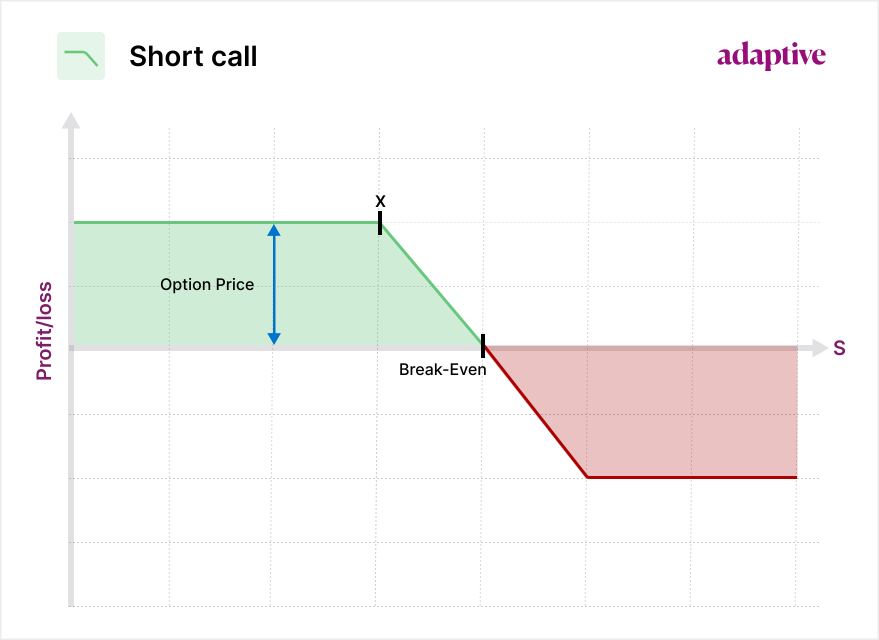
Write covered calls on individual portfolio names to command a premium for idiosyncratic risk, while using proceeds to buy down the portfolio’s diversified risk at a discount with index and individual puts.
Adaptive’s holistic approach to call writing and put buying uses both historical volatility and absolute price levels of individual positions to identify implications across a portfolio.
The interactive call and put writing tools instantly calculates potential income and costs across a whole portfolio, identifying specific expirations and strike prices for options based on user scenarios.
Features
- Test call writing scenarios before you trade
- Analyze income opportunities by position and portfolio
- Optimize call writing and put buying
See for Yourself
Start your 30-day free trial of Adaptive to explore call, put, and collar opportunities for your own portfolios to reduce portfolio risk and increase income.
The Call Writing Tool
Adaptive’s holistic portfolio approach enables you to quickly optimize potential income across individual positions, calculating a top-line revenue number for the portfolio even as you tailor strike prices for absolute price levels and likelihood of execution based on historical volatility. You can also see the specific individual contracts, with strike price and expiration dates, that collectively contribute to the top-line income opportunity for the portfolio.
Selection of Expiration
The pull-down menu for Exp Date sets the expiration date for potential call option contracts. Typical expirations available in the tool are the third Friday of each month so-called “monthlies”, going out up to a year, with additional near-term weekly expiration dates. In general there is more liquidity with monthly contracts out one, two, and three months, and a longer expiration period will command a higher premium—and more income—than a shorter expiration date.
Selection of Strike Price
Toggle between Cap Level and Std Dev to assist in the selection of strike prices for individual positions. Cap Level will use the absolute price level, so that a Global Cap Level of 105 will select strike prices 5% above current levels (e.g. a $100 stock would have a strike price of $105). Changing the Global Cap Level instantly recalculates potential income, with a cap level (less out of the money) generating higher income but also a higher likelihood of the underlying stock rising past the cap level and being called away at the strike price. Toggle to Std Dev to set strike prices instead based on the likelihood of execution (using the historical volatility of the individual position). Personalize further position by position to instantly see the effects on the Premium Total.
Net Collar Calculation
Switch back to the Shield Recommandation screen to see the Call Writing income against the cost of individual and index puts. The general idea of a “collar” is that call writing income can be used to offset the cost of downside protection, selling off upside to hedge against downside and reduce portfolio volatility

The Put Buying Tool use Call Writing text above as a template for the Put Buying tool explanation
The portfolio’s overall risk might be lower than its individual parts due to diversification. This allocation approach has a strong impact on lowering risk
Learn more about “diversification.”
A more volatile position (higher dot) can sometimes have less of an impact on the portfolio’s overall risk (shorter bar) than a less volatile position with a larger portfolio weight. For instance, the volatile Tesla (TSLA) stock might not be a major source of portfolio risk if it’s a small holding compared to a less volatile stock like Pfizer (PFE). Position Risk and Market Risk. Look at the implied volatility of individual positions (the dots) to see how they stack up against the market’s implied volatility.
Risk tools like Portfolio Risk Contribution and Adaptive one-click downside protection can help investors reduce portfolio-specific risk and cut losses. They do this by changing our investment approach to include downside protection.