
Adaptive Backtest
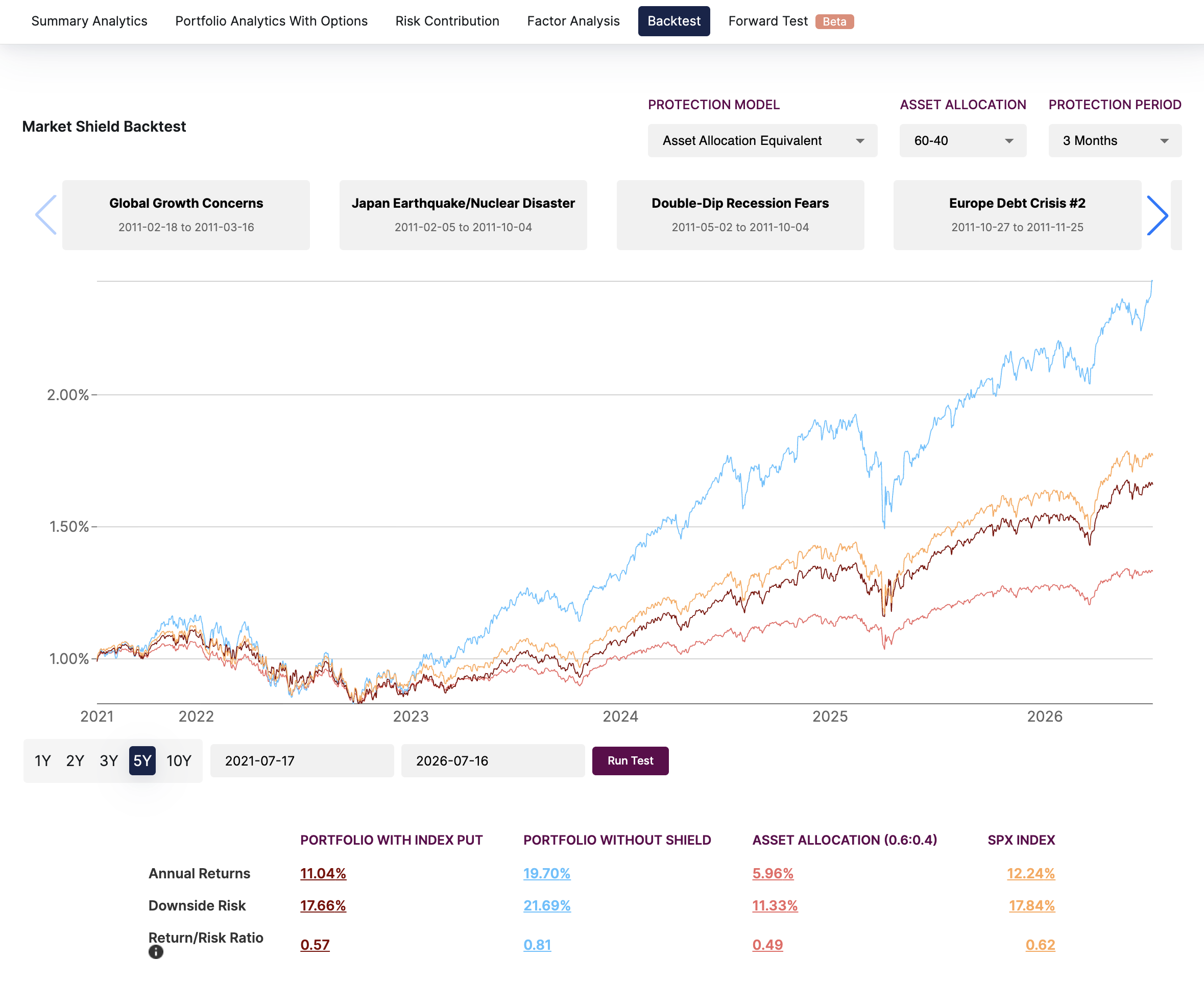
See how your portfolio would have performed in the past with protective puts, with direct comparisons of the hedged portfolio to an asset-allocation benchmark and the unhedged portfolio. The risk-adjusted returns may surprise you, preserving stock market upside with the relative smoothness of a less aggressive stock-bond portfolio.
Downside Protection as a Rebalancing Tool
One key assumption in the Adaptive Backtest is that any put payoffs are invested back in the portfolio, creating the kind of buy-the-dip rebalancing which is also the key to long-term performance for diversified stock/bond portfolios.
Dynamic Protection Level Re-solving: At each roll date (spanning the protection period), Backtest dynamically re-solves the protection strike level using rolling estimates of equity volatility, bond volatility, and equity-bond covariance. It continuously targets a specific downside risk profile (such as a 60/40 asset allocation equivalent) at each rebalance.
Active Overlay Simulation: Strikes for index puts are rolling volatility estimates. Put premiums are deducted at each roll, and put P&L is credited daily to the hedged portfolio value.
Comparative Performance Analysis: Backtest simulates and compares multiple series over historical market scenarios (including recessions and specific timeframes), typically tracking the unhedged portfolio, the hedged portfolio, the broad index, and a target risk benchmark.
Customization: Backtest allows users to customize analysis by parameters such as the protection model, target risk levels, and review time intervals to evaluate how protection would have affected portfolio risk & reward.